Continuous running or switching: what do you want to do?
Choose the kind of operating session to support. Two paper rehearsal scripts that reveal different space needs.
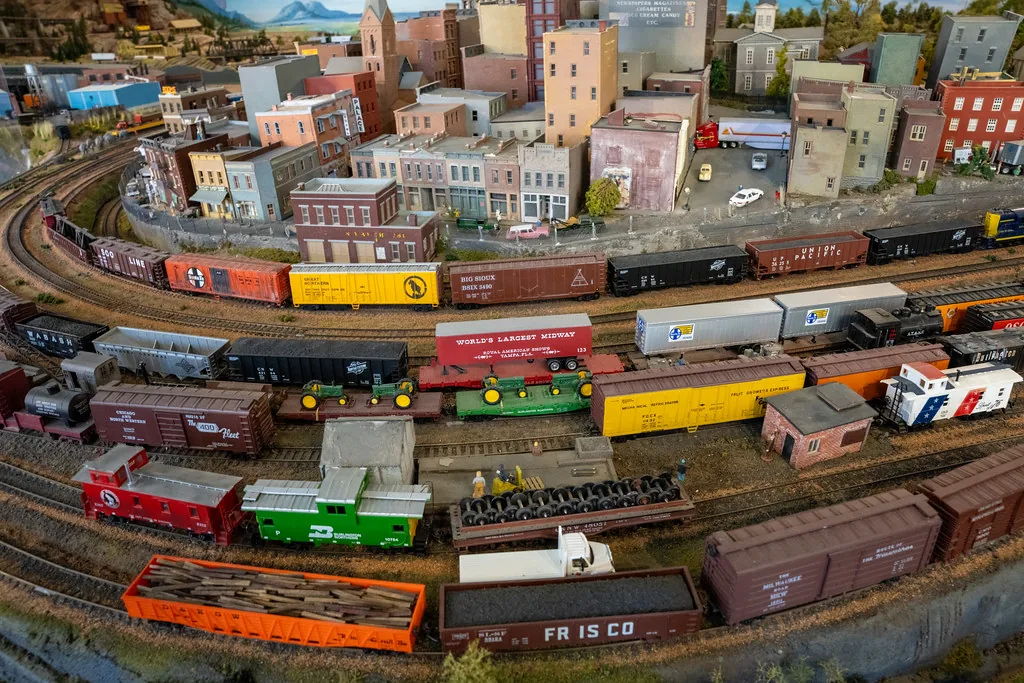
Some evenings a modeller wants to watch a train pass through a carefully composed landscape. On others, the attraction lies in making a sequence of moves work: collecting a car, clearing a route and delivering it somewhere meaningful. Both are valid ways to enjoy a miniature railway. Trouble begins when a plan consumes space for one activity while its owner expects the other.
The NMRA's planning and operations guides connect intended train movements with track arrangements. Rather than beginning with an argument about which style is more realistic, try two short paper rehearsals. They reveal what you want from a session and what the design must provide to support it.
Rehearsal one: a train passes through
Imagine a fictional passenger train appearing from beyond the visible scene, passing a station and leaving towards another destination. Draw the visible journey as a line and place a paper train on it. Ask what happens next. Does the same train return? Must you handle it? Do you want to keep watching while talking with someone else?
A continuous route lets a train circulate without being physically repositioned at every end of the scenic journey. That describes a useful operating property, not permission to ignore the train. Mark where the route turns back and how the return fits within the available room. Add the actual curve requirements of the intended models when those are known, rather than assuming the ends can be squeezed later.
Now describe the view you want to enjoy. If a repeated circuit is acceptable, the landscape may do much of the storytelling. If seeing the identical service reappear immediately breaks the illusion, consider longer off-scene pauses or a different sequence. The solution should respond to your viewing preference instead of hiding an unresolved question beneath a tunnel.
Rehearsal two: a car changes places
For the second exercise, draw a locomotive, an arriving car and a waiting car at a delivery point. Use paper labels so you can move them individually. Define the task: remove the waiting car and place the arriving car at that destination. Work through the sequence without lifting pieces over one another or inventing extra tracks midway.
You may discover that the locomotive needs to reach the opposite end of the cars, or that there is nowhere to hold a car while another is collected. Those discoveries are the value of the exercise. They explain why an apparently modest switching task can require more space than the final delivery position suggests.
Write down every place at which you expect to uncouple or handle equipment. A track behind a tall structure might look attractive while being awkward to use repeatedly. Operation brings attention to the working edge, not merely to the route visible in a photograph.
Compare the kinds of attention
Continuous running and switching ask different things of the operator. Following a train around a scene places emphasis on the journey and its presentation. Switching adds decisions about order, temporary storage and access. The NMRA's operations material shows how destinations, train assembly and car movements can provide purpose beyond circulation.
This does not mean every switching layout needs a complex timetable or elaborate paperwork. A single written task can be enough for an introductory session. Nor does a loop prevent purposeful operation. The useful distinction is between the activities you expect to perform, rather than rigid categories into which the whole layout must fit.
Consider a combined plan honestly
An oval with industry tracks may appear to promise everything, but the operating paths can interfere. A switching locomotive occupying a shared route may stop the circulating train. That may be an enjoyable scheduling problem, or it may prevent the relaxed viewing you wanted. Decide which interpretation applies before calling the combination an improvement.
Rehearse both activities at once with paper labels. Mark where the circulating train must wait and where the operator will stand. If the exercise needs another person, include that person in the room drawing. A design for occasional company should still support the sessions you will actually run alone.
Choose the next design constraint
Complete three sentences: “A satisfying short session includes…”, “I do not want to spend the session…”, and “The design must therefore provide…”. A viewing-led answer might prioritise a continuous route with convincing scenic separation. A task-led answer might prioritise accessible delivery spots and enough temporary space to complete a sequence.
Use these statements when assessing a track plan. A feature that supports neither session may be optional, however impressive it looks. Keep the paper rehearsals as part of the brief and repeat them after major revisions. They do not verify wheel, coupling or electrical performance, but they do establish a coherent purpose for the railway those systems will eventually serve.
If your preference changes between weekdays and exhibition days, retain two session descriptions. Designating one as the everyday priority makes occasional compromises easier to assess without dismissing either use.
Take it to the workbench
A field sheet for this article. Use your browser’s print command or copy the headings into your project notebook. Keep facts, observations and open questions distinct.
| First train movement | Your notes |
|---|---|
| Next required movement | Your notes |
| Temporary car positions | Your notes |
| Operator access | Your notes |
| Everyday priority | Your notes |
Choose the everyday priority
Hypothetical worked example. The fictional operator wants to watch a circulating passenger train while explaining the scene. A freight exchange occupies its only route. Giving that exchange a separate session preserves the everyday goal without claiming a second independent operating circuit.
This is an editorial exercise, not a report of a physical test.
Sources & further reading
- National Model Railroad Association — Layout Planning
- National Model Railroad Association — Operations
Sources support the factual background. Worksheets and hypothetical exercises are editorial proposals, not reports of tests performed by this publication. Consult the relevant current product documentation before applying product-specific advice.