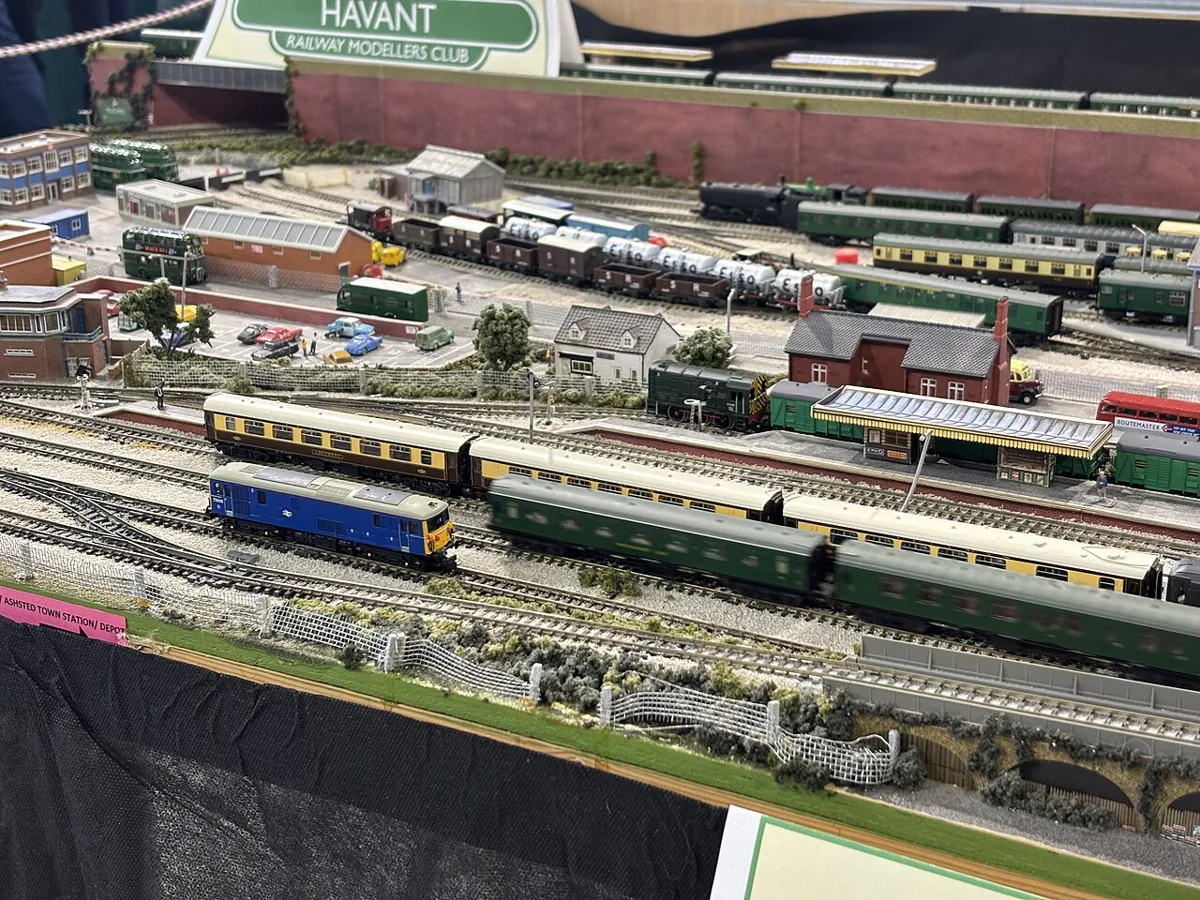
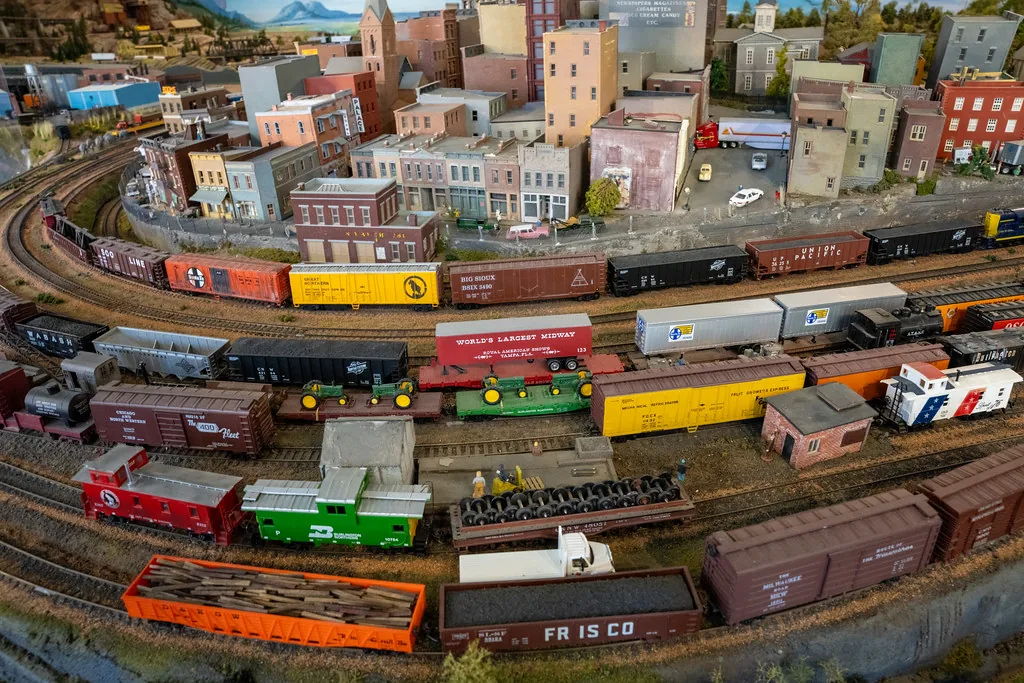
Give the rest of the railway somewhere to go
Plan off-scene train storage. A train-to-storage matrix rather than a track-count target.
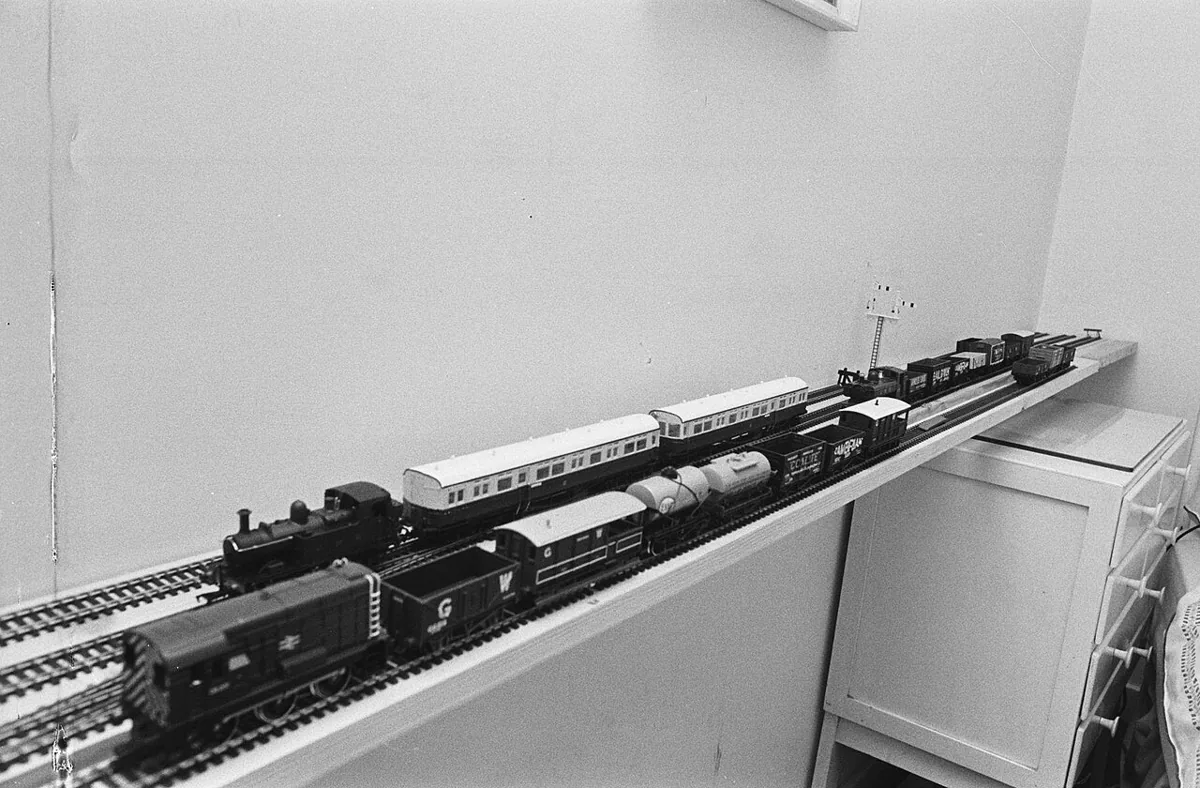
A train disappearing behind the scenery has not stopped occupying space. It still needs somewhere to stand, a way to return or a procedure for being removed. Planning only the visible station leaves those decisions until the least convenient moment. Staging is the part of the design that lets a small scene suggest a larger railway without requiring every destination to be modelled.
The NMRA's operations guide describes staging as a place where trains can be assembled for later appearance. Its layout-planning guide connects storage, movement and available space. Begin with the services you intend to show, then determine their storage needs. Counting tracks first reverses that reasoning.
List appearances before tracks
Write down the trains that appear during one intended session. Give each a simple identity and note whether it begins outside the scene, ends outside it, or stays within the visible railway. Include the locomotive and all vehicles when recording an assembled train's length. Use actual measurements when available and mark estimates clearly.
For a fictional example, imagine an arriving passenger service, a local freight and a returning passenger service. These are three appearances, but not necessarily three physical trains. If the same passenger train can be repositioned between appearances without disrupting the session, it may serve twice. If it must remain untouched while the freight operates, its storage becomes a separate requirement.
Make a train-to-space matrix
Draw a table with session moments across the top and physical trains down the side. In each cell write visible, waiting, being handled or finished. The number of trains waiting at the same moment is more informative than the number of services in the story. Add a note wherever one train prevents another from entering or leaving.
Do not treat every empty cell as spare capacity. A track may be unavailable because the route through it is occupied, or because the intended locomotive cannot reach the required end of its train. Annotate those dependencies. The matrix turns an attractive but abstract service list into a concrete question about simultaneous occupancy and access.
Separate storage from train assembly
A place to hold an intact train is not automatically a convenient place to sort cars. The NMRA discusses classification and train preparation as operating activities in their own right. If you expect to assemble trains in the staging area, write down the necessary moves and identify the working space they occupy.
Alternatively, you might prepare trains before the session and leave staging largely unchanged while operating. That can simplify the job, but it creates a setup task elsewhere. Record where cars are kept before assembly and where a completed train waits. The work has not disappeared simply because it occurs outside the scenic boundary.
Design for seeing and reaching
Hidden from visitors should not mean hidden from the operator responsible for a problem. Mark how each storage track will be inspected, cleaned and reached. Consider an unsuccessful coupling or a derailed vehicle at its least accessible position, with neighbouring tracks occupied as they would be during a session.
A removable scenic cover needs a clear lifting route and a place to rest. Access from beneath requires an appropriate opening and a practical working position. Neither solution should depend on leaning over fragile scenery. This is an access-planning exercise; selecting structural supports and electrical arrangements requires the relevant construction and product information.
Compare handling arrangements
Some modellers use conventional tracks beyond the scenic section; others use removable train-holding arrangements or manual repositioning. Each approach changes the amount of handling and the space used during setup. Evaluate the actual procedure rather than assuming portability or automation makes it effortless.
Write a handling sequence for the intended arrangement. Name what is moved, where hands support it, what must be disconnected and where the equipment rests afterwards. If the sequence cannot be described clearly without referring to an improvised clear patch on the floor, reserve a proper working location before finalising the design.
Give the off-scene area an acceptance test
Run the paper session from start to finish and verify that every appearance has a physical place before and after it enters the scene. Check that a waiting train does not block the next required movement. Then repeat the sequence with the intended operator positions drawn on the room plan.
The result may suggest fewer services, shorter trains or more accessible storage rather than more track. Record which compromise preserves the experience you value. Staging works when its ordinary procedure is understandable and repeatable. A convincing distant world depends less on the number of unseen sidings than on whether the trains can actually complete the journeys your visible railway promises.
Label storage positions consistently with the session sheet. An operator should not have to translate between a hidden track number, an informal nickname and a destination label while deciding which train must appear next.
Take it to the workbench
A field sheet for this article. Use your browser’s print command or copy the headings into your project notebook. Keep facts, observations and open questions distinct.
| Service appearance | Your notes |
|---|---|
| Physical train identity | Your notes |
| Waiting position | Your notes |
| Simultaneous occupancy | Your notes |
| Handling sequence | Your notes |
Read simultaneous occupancy
Hypothetical worked example. At moment one, passenger set P is visible and freight F is waiting. At moment two, P waits while F is visible. The matrix has two physical trains, not three because P appears again. It still needs a clear route for either train to leave its waiting position.
This is an editorial exercise, not a report of a physical test.
Sources & further reading
- National Model Railroad Association — Operations
- National Model Railroad Association — Layout Planning
Sources support the factual background. Worksheets and hypothetical exercises are editorial proposals, not reports of tests performed by this publication. Consult the relevant current product documentation before applying product-specific advice.