Design a layout for the journey out of the room
Decide transport boundaries before construction. A door-to-storage route audit with a packing inventory.
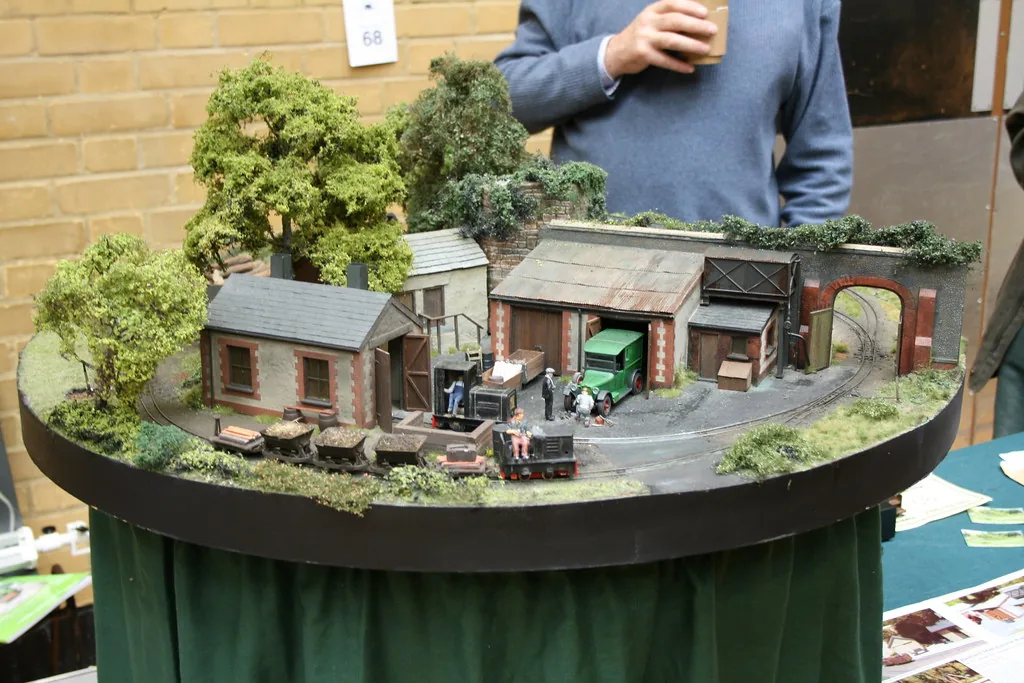
Portability begins before the layout reaches a car or exhibition hall. It begins with the doorway, the corner outside the room, the storage shelf and the person who must move each part. A board that can be detached is not necessarily a board that can be transported conveniently. Plan the complete journey while the dimensions are still easy to change.
The NMRA describes modules as portable sections designed to interface with a wider system. FREMO's N-RE frame guidance illustrates how connectors, mechanisms and handling considerations belong in construction planning. Those documents describe particular contexts; the route audit below is a separate exercise for assessing your own transport problem.
Follow the route in both directions
Walk from the proposed layout position to its storage or transport destination. Note every doorway, turn, step and place where the available space narrows. Include the return journey, because a part unloaded in a different orientation may be awkward to bring back indoors.
Measure obstacles and draw the proposed package rather than just the bare board. Scenery, handles, protective covers and projecting fittings can change the outer dimensions. A cardboard outline can help explore the path without risking models, but it does not reproduce the weight or handling behaviour of a completed section. Treat dimensions and carrying ability as two different checks.
Decide what travels together
Separate permanent scenery from loose equipment and removable structures. A station building may travel attached to the board or in its own container; each option changes both packing work and exposure to damage. Neither is automatically better. Choose according to the actual model and the journey it must make.
Create a packing inventory with one line per travelling item. Record its container, orientation, destination and relationship to other parts. Include small essentials such as joining hardware and the documentation needed to reassemble the layout. An excellent scenic board is not useful at a venue if its connecting parts remain in an unlabelled drawer at home.
Draw boundaries around complete tasks
Choose board divisions with track, structures and operating arrangements in mind. A convenient woodworking division may cut through a complex scenic structure or place a delicate connection at an exposed corner. The NMRA's modular discussion makes clear that interfaces need agreed specifications rather than improvised connections.
Where the layout must join a club system, obtain that group's actual requirements before building the ends. FREMO's N-RE guidance is evidence that one system defines specific profiles and construction details, not evidence that those values apply to all modules. Record the chosen system and edition alongside the intended join. Do not combine unrelated standards because both use the word modular.
Plan the assembly scene
Picture the layout arriving at its destination. Where are containers placed before the first section is erected? Which parts must be assembled before others, and can the person doing that work reach the connections? Draw this temporary working area as carefully as the final display footprint.
Write an assembly sequence in ordinary language. Identify any task that requires help and any operation that must wait until another part is stable. Do not invent a load rating or assume a person can safely lift an unspecified weight. The practical goal is to expose dependencies so the construction and handling arrangement can be assessed appropriately.
Protect the vulnerable edges
Track ends, small scenic details and projecting mechanisms deserve particular attention during packing. Mark their locations on a simple diagram of each section. Then show which surfaces may contact the protective container and which must remain clear.
Protection should not rely on loose packing rubbing against delicate models. Nor should a cover be treated as a carrying structure unless it was designed and verified for that purpose. Keep material and support choices specific to the actual build. A transport plan describes what needs protection; it does not establish that any convenient sheet or box will provide it.
Rehearse a complete cycle
Before an important journey, document a full setup, pack-down and storage cycle in a suitable setting. Record omissions, confusing labels and any point at which a component had no safe temporary location. Photographs of the packed arrangement can make the next cycle easier to reproduce.
Use the rehearsal to revise the inventory and sequence, not to claim universal durability. A successful trip under one set of conditions does not prove performance under every journey. The useful achievement is a portable railway whose parts, connections and handling steps are understandable. When the route and the packing procedure shape the design from the start, portability becomes a repeatable activity rather than a difficult surprise at the end of construction.
Give each container the same identifier as its inventory entry. Keep an accessible copy of the packing list outside the packed layout, so the instructions do not become the final item trapped behind the parts needed first.
Take it to the workbench
A field sheet for this article. Use your browser’s print command or copy the headings into your project notebook. Keep facts, observations and open questions distinct.
| Complete package dimensions | Your notes |
|---|---|
| Door-to-storage route | Your notes |
| Loose components | Your notes |
| Assembly dependency | Your notes |
| Packing-list location | Your notes |
Test the packed outline
Hypothetical worked example. A bare board passes a doorway; the cardboard outline including its protective case cannot turn in the corridor. The packing plan fails before weight is considered. Revise the package dimensions or board division, then assess handling separately with suitable help.
This is an editorial exercise, not a report of a physical test.
Sources & further reading
- National Model Railroad Association — Building Benchwork
- National Model Railroad Association — Introduction to Layout Modules
- FREMO — Frame of a Module
Sources support the factual background. Worksheets and hypothetical exercises are editorial proposals, not reports of tests performed by this publication. Consult the relevant current product documentation before applying product-specific advice.