Build a reference notebook without losing the source
Track reference material and permissions. A source card separating observations, rights and interpretation.
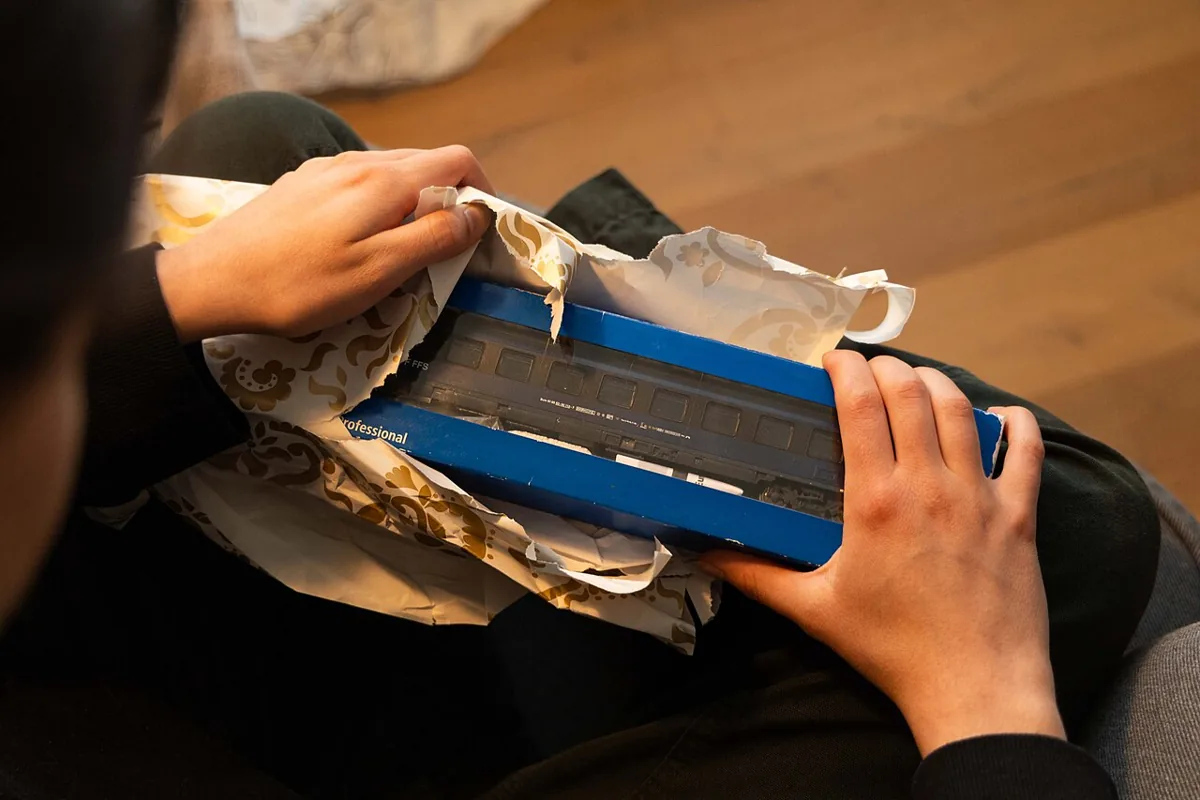
A folder of appealing railway photographs can inspire a scene while failing to answer the questions that arise during construction. Which image showed that entrance? Was the date documented or guessed? Can the photograph be reproduced on an exhibition panel? A reference notebook is useful when it preserves those distinctions rather than merely collecting images.
Library of Congress guidance provides a basis for careful handling and personal digital organisation. The NMRA structures guide discusses plans, photographs and mock-ups as modelling resources. The source card proposed here connects reference material with an actual decision while keeping observation, interpretation and permission as separate parts of the record.
Give the reference an identity
Assign a short source identifier and record the original title, creator where known, publisher or collection, source URL and access date. Preserve any catalogue number supplied by the institution. If a source is a physical document, record where it is held and how you consulted it.
Avoid treating the filename on a repost as an authoritative title. Follow the trail to the original record where practical, and keep uncertainty if it cannot be resolved. A reference can remain useful for general inspiration without becoming reliable evidence for a precise date, location or object identity.
Record the question it answers
Link the source with a modelling task: identifying a building footprint, checking a vehicle variation or observing a ground relationship. Describe the actual evidence relevant to that task. A source with an impressive institutional name is not automatically useful for every question in the project.
Write where the relevant detail appears, such as a figure, page or identifiable part of an image. This makes later review quicker and helps another person check your interpretation. Do not preserve only the conclusion when the supporting detail can be pointed to directly. The notebook should shorten the path back to the evidence.
Keep observation separate
Describe what the source visibly shows or explicitly states. Use neutral language and retain qualifiers. A photograph may show an opening without establishing whether it was the public entrance. A drawing may identify a proposal rather than an arrangement actually constructed.
In another field, write your interpretation and its confidence. State when you are using an image as inspiration for a fictional scene. This separation prevents an attractive idea from acquiring a false factual basis simply because it has been repeated in several project notes. If the evidence changes, the original observation can remain intact while the interpretation is revised.
Track dates carefully
Distinguish the date of the depicted scene, the date of a drawing revision and the date of digital publication. Preserve a source's approximate date as approximate. Do not turn a broad catalogue range into an exact year because a layout needs a tidy label.
When sources disagree, record the conflict and the practical consequence for your model. You may need another reference, a narrower claim or a deliberate approximation. Avoid resolving disagreement by averaging dates or choosing the one that fits your preferred arrangement. The notebook is valuable when it exposes an unresolved question early enough to change the plan.
Add a rights field
Research access and permission to reproduce are different matters. Record the stated license or rights information and the page where it appears. Include any credit or modification requirements relevant to your intended use. A source being downloadable does not by itself establish reuse permission.
Keep personal research copies separate from assets cleared for public presentation. Before publishing, verify that the permission applies to the actual item, the proposed use and any modifications. If the basis is unclear, use the reference for lawful study within its terms or choose another public asset instead of inventing a license from a familiar-looking website.
Preserve working material appropriately
For physical paper and photographs, use guidance suited to their actual format. The Library of Congress warns against practices that can damage paper and explains that photographic materials can have distinct needs. Put notes on separate working records rather than marking fragile originals for convenience.
For digital files, keep stable identifiers, readable descriptions and an understandable folder structure. Retain source links even when a local copy exists. Plan accessible backups and verify that files can be opened. The purpose is to preserve both the image and the context that makes it usable; one without the other can leave a future modeller guessing.
Close the loop with the model
When a decision is made, link the source card to the relevant drawing, sample or construction note. State which part of the source influenced the result and which parts are your adaptation. Preserve declined references where they explain an important choice, without treating every saved image as a requirement.
Review unresolved cards before permanent work. A good reference notebook does not promise certainty about every detail. It lets you find the evidence, understand its limits and distinguish what the source establishes from what you have chosen to build. That is what turns a collection of pictures into a practical research tool.
Take it to the workbench
A field sheet for this article. Use your browser’s print command or copy the headings into your project notebook. Keep facts, observations and open questions distinct.
| Original source identifier | Your notes |
|---|---|
| Question supported | Your notes |
| Observation versus interpretation | Your notes |
| Date uncertainty | Your notes |
| Rights and modelling-decision link | Your notes |
A source that cannot date a scene
Hypothetical worked example. Reference R-12 shows an entrance, but its caption supplies no date. Use it for the visible opening and mark the period unresolved. A repost's upload year does not fill that gap, and a public download does not fill the rights field.
This is an editorial exercise, not a report of a physical test.
Sources & further reading
- Library of Congress — Care, Handling, and Storage of Works on Paper
- Library of Congress — Personal Archiving
- National Model Railroad Association — Structures
Sources support the factual background. Worksheets and hypothetical exercises are editorial proposals, not reports of tests performed by this publication. Consult the relevant current product documentation before applying product-specific advice.