The space around a train matters too
Understand why body clearance exceeds track gauge. A clearance sweep plan separating straight and curved tests.
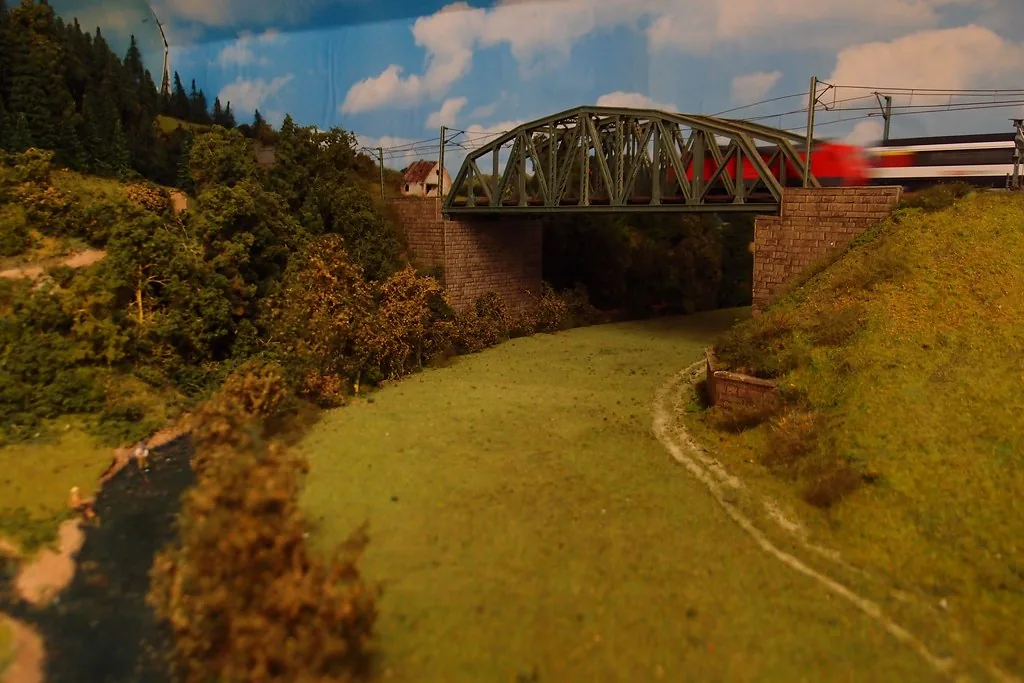
The rails show where the wheels run. They do not show every place the rest of the vehicle can occupy. A coach roof, a cylinder cover or a body end can approach scenery even when the wheels remain correctly on the track. Clearance planning therefore needs a picture of the moving vehicle, not just a correctly measured track gauge.
The NMRA planning guide includes curved-track clearance in its discussion of layout geometry. Its track and rolling-stock guides connect curves, couplings and vehicle length. The exercise below separates the questions that a simple straight-track check can answer from those requiring a look at the actual route and equipment.
Identify the complete vehicle
Record the exact model and its configuration. Projecting details, fitted accessories and coupling arrangements can affect what must be considered. A body shell's width alone does not describe the whole moving object, and a generic scale label cannot replace the manufacturer's relevant dimensional information.
List the proposed fixed objects near the track: platform edges, bridge openings, tunnel scenery, walls and trackside details. Include overhead objects where relevant. For each, note whether its position is already fixed, adjustable or still a paper proposal. This gives the clearance exercise a practical target instead of a vague intention to leave enough room.
Begin on the straight
Use the applicable current standard and suitable checking method for the actual modelling system. Establish what the gauge or template checks and what it does not. A tool intended for one group of dimensions should not be assumed to verify every accessory or operating condition.
Make a record of the proposed obstacle, its reference position and the evidence used. Where a physical trial is appropriate, keep the scenery temporary and use the intended equipment carefully. Do not force a model past an obstruction to discover whether it fits. An initial conflict is a reason to stop and investigate, not to accept a scraping contact as ordinary operation.
Treat curves as a separate case
A long body supported at two points follows a different path from the track centreline around a curve. Its ends and middle can approach different sides of the surrounding space. That geometric relationship explains why a clearance that appears generous on a straight section may be insufficient elsewhere.
Check the actual curved route, including transitions and neighbouring track. Avoid a universal extra-distance rule detached from radius and vehicle geometry. Use the relevant standard, current product information and appropriately planned trials. The most demanding vehicle on one part of the route may not be the same vehicle on another, particularly when projecting details differ.
Include the coupling relationship
Two coupled vehicles create a different situation from a single loose vehicle. The NMRA track guide discusses the problems that reverse curves can create with body-mounted couplings. Clearance planning should therefore consider the intended train and movements rather than checking only an isolated car.
Mark locations where direction changes rapidly, where a crossover occurs or where vehicles pass a structure while coupled at an angle. Keep the mechanical question separate from the scenic question: a body might clear a wall while the coupling arrangement still cannot negotiate the geometry reliably. Both need evidence before the surrounding scene becomes permanent.
Examine passing movements
If two tracks are intended to carry trains simultaneously, consider both occupied at once. A paper plan showing two centre lines does not demonstrate that long bodies can pass on adjacent curves. Identify the actual vehicles, movement directions and track geometry involved in the proposed encounter.
Use a simple encounter record with location, vehicle pair, curve description, evidence and unresolved issue. This is especially useful at platforms or bridges, where moving one obstacle later could disturb a large scenic area. An observed successful pass in one configuration should be recorded as that configuration, not promoted into a claim that every future vehicle will pass safely.
Make scenery wait for evidence
Give each critical obstacle a temporary outline or removable mock-up before final installation. Confirm access for inspection and recovery as well as nominal passage. A tunnel mouth may have adequate space for a running train while hiding a difficult-to-reach section immediately beyond it.
Finish with a route map showing where straight checks, curved sweeps and passing encounters were assessed. Record tools and applicable references, plus the model configurations used. Retain unresolved locations visibly in the construction plan. A clearance envelope is useful when it connects the track, the complete vehicle and the surrounding scene; it should not be reduced to a reassuring number copied from a different situation.
Revisit that map when a platform moves, scenery is added or the roster changes. Keep photographs of the original mock-up beside the revised arrangement. A previous result remains useful evidence, but its applicability depends on the geometry and equipment remaining the same. Describe any changed assumption before reusing the earlier conclusion.
Take it to the workbench
A field sheet for this article. Use your browser’s print command or copy the headings into your project notebook. Keep facts, observations and open questions distinct.
| Complete vehicle configuration | Your notes |
|---|---|
| Obstacle reference | Your notes |
| Straight-track evidence | Your notes |
| Curved and coupled encounter | Your notes |
| Remaining scenery access | Your notes |
One pass is not the route
Hypothetical worked example. Coach A clears a temporary wall alone. Coupled to coach B on the reverse curve, a connection reaches its limit. The scenic gap and coupled movement require separate entries; the first result cannot pass the second test.
This is an editorial exercise, not a report of a physical test.
Sources & further reading
- National Model Railroad Association — Layout Planning
- National Model Railroad Association — Laying Track
- National Model Railroad Association — Motive Power & Rolling Stock
Sources support the factual background. Worksheets and hypothetical exercises are editorial proposals, not reports of tests performed by this publication. Consult the relevant current product documentation before applying product-specific advice.