Make a compatibility card before buying rolling stock
Record what a model must match. A purchase checklist for geometry, couplings and control documentation.
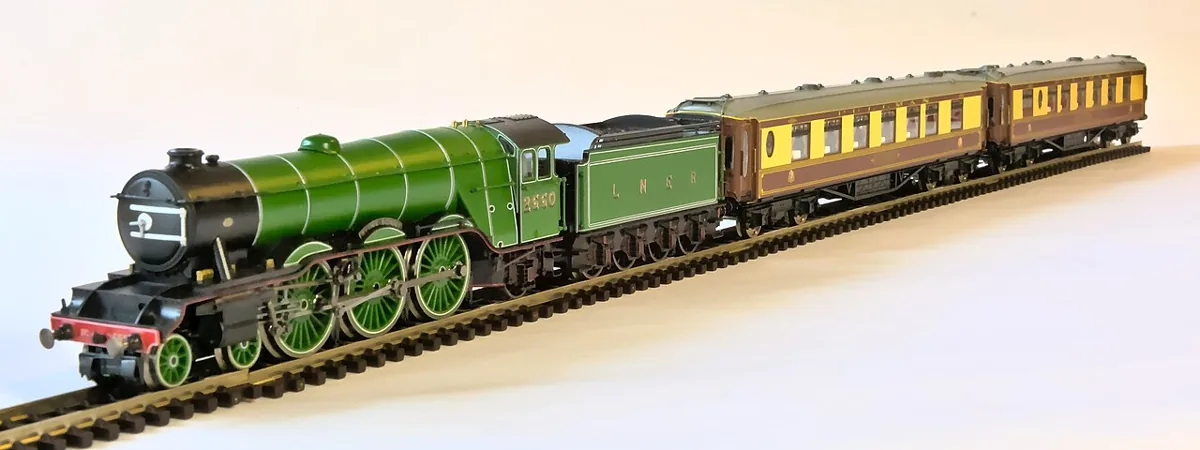
A model can match the scale printed on your collection boxes and still require further investigation before it joins a train. Gauge, curves, couplings and control requirements are different questions. A purchase decision becomes clearer when those questions are recorded separately, with an actual source for each answer and an honest space for what remains unknown.
The NMRA's introductory and rolling-stock guides discuss equipment choices and coupling arrangements. Its track guide explains interactions between vehicles and geometry. A compatibility card combines these concerns around one proposed model. It is a decision aid, not a certification or a recommendation to buy any named product.
Identify the exact version
Begin with manufacturer, model reference and the precise version under consideration. Similar-looking releases can differ in fitted equipment or details. A photograph, a retailer's abbreviated title or the name of the real locomotive may not identify the model sufficiently.
Add the source of the offer and the date you checked it. Distinguish statements copied from current manufacturer documentation from a seller's description and your own observations. If the description is incomplete, ask for the missing specification before treating the model as suitable. An uncertainty discovered before purchase is information, not an inconvenience to be hidden.
Define what it must match
Describe the intended railway rather than writing “my layout.” Record its modelling convention, track gauge, relevant track system and important geometry. Identify the train or task the model would join. A vehicle intended for display has a different compatibility question from one expected to perform repeated switching moves.
Keep this layout information as a reusable reference, but check that it remains current. A modified crossover or newly added platform can change the context without altering the scale name. The card should connect the proposed model with the actual railway, not a simplified label that no longer describes its most demanding locations.
Investigate geometry
Find the model's documented curve and clearance requirements where available. Compare them with the intended route, including transitions and reverse curves. The NMRA track guide explains why coupled vehicles can encounter difficulties at changes of direction even when an isolated curve looks acceptable.
Record the full source and any qualification. A seller's statement that a model runs on standard curves is not a precise radius. Nor does a minimum-radius statement establish the appearance you want in the scene. Separate documented operating limits, remaining uncertainty and visual preference so the purchase decision does not turn an aesthetic judgement into a technical claim.
Describe the coupling task
Note the installed coupling arrangement and what it must connect to. Identify whether the intended session requires automatic coupling, manual handling, delayed uncoupling or simply an assembled train left intact. Those are different tasks even when the vehicles can physically be linked.
Do not assume that a familiar coupling name settles mounting height, pocket arrangement or behaviour on the chosen geometry. Consult the relevant product information and applicable standards. If adaptation is proposed, record the actual parts and instructions required. A vague promise that a model can be converted is not the same as an established conversion for the exact version you intend to buy.
Check control documentation
For powered equipment, preserve the manufacturer's description of its fitted control equipment and requirements. Terms such as ready and equipped should lead to the exact instructions rather than an inference about what is inside the model. Identify any separate component that the proposed use requires.
Keep the check at the level of documented compatibility unless you have appropriate expertise to assess the technical installation. This card is not a wiring guide. If information conflicts between a seller and a manual, verify the version and ask for clarification. Do not select whichever answer makes the purchase appear easier.
Include the collection relationship
Technical suitability is distinct from the model's role in your scene. Record whether its prototype, period and visual character support the railway you intend to depict. A deliberately mixed collection is a valid choice, but it should not be described as historically consistent without evidence.
Finish with three possible outcomes: requirements documented as a suitable match, a named question still unresolved, or unsuitable for the intended use. Add the next action beside an unresolved item, such as obtaining a manual or checking an actual sample with permission. The card earns its place when it turns enthusiasm into a specific, answerable decision and prevents missing specifications from becoming expensive assumptions after delivery.
Keep the card after purchase and link it to the collection entry. Record any substitutions between the version researched and the item received. A change of fitted coupling, decoder or wheelset should trigger a review of the relevant field, without erasing the original specification. That history makes the card useful for maintenance and future sale as well as the initial buying decision. Retain its dated sources too.
Take it to the workbench
A field sheet for this article. Use your browser’s print command or copy the headings into your project notebook. Keep facts, observations and open questions distinct.
| Exact proposed version | Your notes |
|---|---|
| Railway requirements | Your notes |
| Geometry documentation | Your notes |
| Coupling and control requirements | Your notes |
| Unanswered question and next action | Your notes |
A purchase on hold
Hypothetical worked example. The seller identifies the locomotive version and gauge but supplies no manual for the fitted control equipment. Mark identity documented, gauge provisionally matching, and control unresolved. Request that manual before purchase; a familiar paint scheme answers none of the missing technical questions.
This is an editorial exercise, not a report of a physical test.
Sources & further reading
- National Model Railroad Association — Motive Power & Rolling Stock
- National Model Railroad Association — Laying Track
- National Model Railroad Association — Getting Started
Sources support the factual background. Worksheets and hypothetical exercises are editorial proposals, not reports of tests performed by this publication. Consult the relevant current product documentation before applying product-specific advice.