Match a freight car to the place it serves
Link model industries to believable traffic. A cargo flow sketch with arrival and departure states.
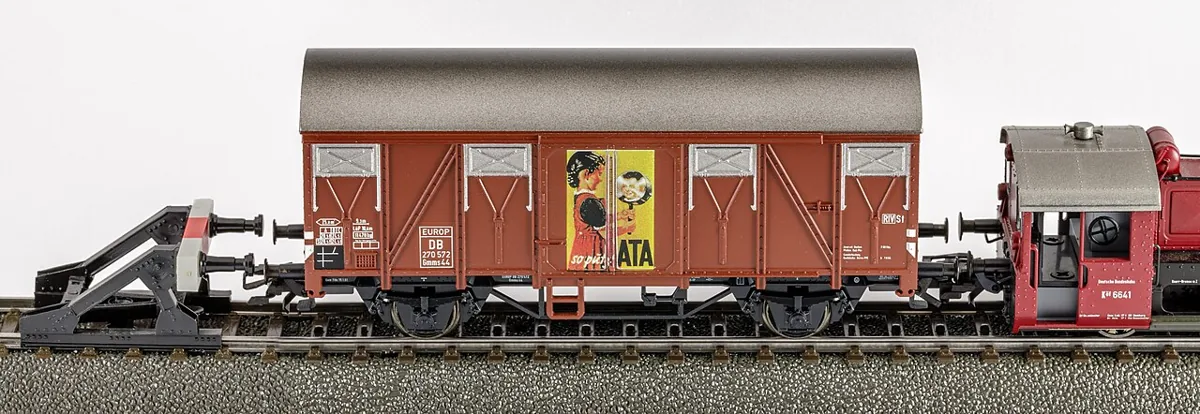
A freight siding becomes more interesting when its vehicles appear to have a reason for arriving. That reason does not need an elaborate factory complex. It needs a believable relationship between a customer, a load, a place to transfer it and the railway movement that serves it. Planning those relationships can make a small scene feel more purposeful than a larger collection of unrelated wagons.
The NMRA rolling-stock guide discusses vehicle types in relation to era and location. Its operations guide connects cars with destinations, while its structures guide describes industries as railway customers. The cargo-flow exercise below uses those principles to design a fictional activity without inventing facts about a real business.
Choose a customer question
Begin with the kind of activity you want the scene to suggest. Is material arriving for use, leaving as a product or passing through a transfer point? Write the answer as a movement rather than merely naming a building. “Receive a load and release an empty vehicle” is more useful for the exercise than “add an industry.”
If the scene depicts a real place or period, research the actual traffic and facilities before selecting equipment. A building's appearance alone cannot establish the commodities it handled or the vehicles used. For a fictional scene, label the proposed flow clearly and avoid attaching an invented operating history to an actual company.
Draw the load's route
Use arrows to connect the arriving vehicle, the transfer point and the customer's working area. Add the return route where applicable. The sketch should show how the load reaches its destination after the train stops. A rail-side door or crane is meaningful only if it connects with a plausible working space.
Do not attempt to reproduce an engineering layout without evidence. The purpose is to catch obvious scenic contradictions, such as a loading position blocked by a wall or a road arriving on the inaccessible side of a yard. Research exact machinery and handling methods if those details become central to the scene's claim of accuracy.
Match the vehicle to the task
Choose a vehicle type whose documented use suits the intended flow, considering the modelled region and period. The NMRA guide lists several broad categories, but broad classification is a starting point rather than evidence for every specific cargo assignment.
Record the source behind a historically specific pairing. If the evidence is insufficient, narrow the description to what can be supported or keep the example fictional. Do not select a wagon merely because its colour looks attractive beside the factory and then describe the combination as typical. Technical and historical suitability should remain separate from visual preference.
Give the vehicle a state
For each appearance, write arriving, waiting, loading or unloading, ready to leave, or passing through. The chosen states define what changes during a session. A model load may remain physically unchanged while paperwork represents a different state, but the operating arrangement should explain that convention.
Consider a hypothetical covered-goods customer receiving one car and releasing another. The session needs a place for the released car while the arrival is positioned. That temporary space may be more important to the operation than a second decorative building. Use paper vehicle labels to work through the sequence before deciding how much track the industry needs.
Connect the siding with the railway
Trace how the train reaches the customer and leaves again. Identify which moves occupy a shared route, which require uncoupling and where the locomotive must stand. The operations guide explains how car movements can give a railway purpose; the scenic customer should support that purpose instead of blocking it.
Decide whether the loading position must be directly accessible to the modeller. Frequent manual coupling behind a tall structure can make a good-looking scene frustrating. Adjust building placement or the operating convention before the ground and structures become permanent. The miniature road network and the real operator's reach are different requirements, and both deserve space.
Use selective detail
Choose a few details that explain the activity: a relevant entrance, a clearly placed loading area or a supported model load. Research signs and equipment before presenting them as period-specific. A busy yard of random accessories may obscure the relationship the scene was meant to communicate.
Keep removable loads and small details compatible with the chosen handling procedure. Do not let scenic presentation create an unexplained obstacle to cleaning, rerailing or removing a vehicle. A useful scene should remain understandable both as a fictional working place and as a practical part of a model layout.
Retain a traffic card
Finish with customer, proposed cargo, vehicle type, source basis, arrival state, departure state and the required movement sequence. Add a separate note for unresolved historical evidence. This card can become the basis of a simple session instruction.
Review it after using the scene. If the operation feels repetitive, investigate a different sequence or state change before adding more track. A convincing freight customer is defined by a coherent flow through the place, not by the number of buildings or wagons that can be packed around it.
Take it to the workbench
A field sheet for this article. Use your browser’s print command or copy the headings into your project notebook. Keep facts, observations and open questions distinct.
| Customer and evidence basis | Your notes |
|---|---|
| Cargo route | Your notes |
| Vehicle type source | Your notes |
| Arrival and departure states | Your notes |
| Required movements | Your notes |
One exchange, one customer
Hypothetical worked example. Customer C has loaded car B at its door and expects arriving car A. The paper sequence must provide somewhere for B while A is positioned. The scene's customer role differs from the operator's movement instructions, which still need a feasible track arrangement.
This is an editorial exercise, not a report of a physical test.
Sources & further reading
- National Model Railroad Association — Motive Power & Rolling Stock
- National Model Railroad Association — Operations
- National Model Railroad Association — Structures
Sources support the factual background. Worksheets and hypothetical exercises are editorial proposals, not reports of tests performed by this publication. Consult the relevant current product documentation before applying product-specific advice.