Long coaches change the whole scene
Assess passenger train length beyond platform appearance. A train-length budget including storage and curves.
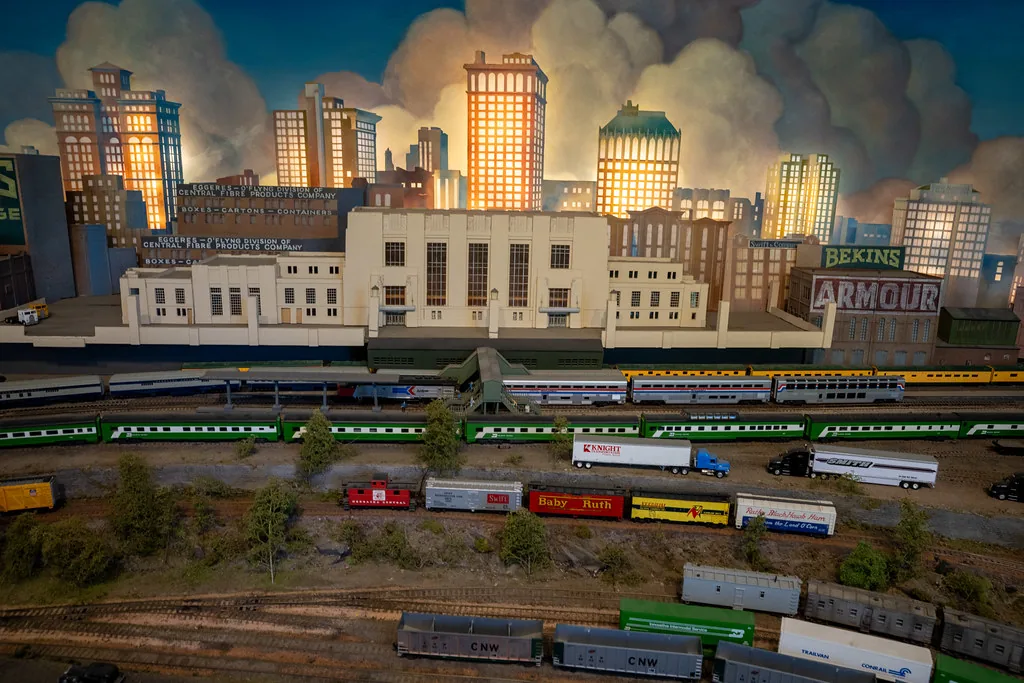
A long passenger train changes more than the length of a platform. It changes the space needed while waiting, the appearance of curves and the relationship between vehicles at direction changes. Planning it as a row of coaches beside a station can therefore miss the parts of the railway that determine whether the service is practical at all.
The NMRA rolling-stock guide highlights the importance of considering passenger equipment during track planning. Its layout and operations guides connect train length with passing and storage arrangements. A train-length budget follows one intended service through the whole railway, keeping appearance and mechanical requirements as related but distinct questions.
Measure the train you mean
Identify the actual models, including locomotive, coaches and relevant coupling arrangement. Measure or document the assembled train rather than multiplying an approximate body length by the number of vehicles. Keep assumptions visible if equipment has not yet been chosen.
Record more than one intended formation if the service varies. A short everyday set and a longer exhibition formation make different demands. Decide which formation defines the essential layout requirement. Otherwise a rarely used imagined train can quietly dictate every storage track and curve while the ordinary session receives little attention.
Follow the complete journey
List every position where the train must stop, wait, pass another movement or be handled. Include off-scene storage and any location used to change ends. The shortest relevant position may constrain the service more than the main platform does.
Make a simple route sheet with the location, usable space, intended action and source of the measurement. A space is usable only for the relevant movement; a turnout throat or obstruction can prevent a nominal track length from being available for standing equipment. Identify such boundaries explicitly instead of treating every visible rail as storage capacity.
Inspect curves with the actual equipment
The appearance and operating requirements of a vehicle depend on more than its general category. Consult the exact model's current documentation for minimum-radius and other relevant requirements. Avoid borrowing a successful radius from a different coach simply because both belong to the same scale.
Long bodies and their couplings can create relationships that are difficult to judge from a centreline drawing. The NMRA planning discussion addresses reverse curves and the space between changes of direction. Mark those locations for closer assessment. A successful movement around one isolated curve does not establish that the full station approach or crossover will work in the intended formation.
Give the platform a defined role
Decide which part of the passenger activity the scene is intended to show. A full-length representation and a selectively compressed scene make different promises to the viewer. If the platform is deliberately shortened, describe that as a modelling choice rather than a historically accurate dimension without evidence.
Consider the relationship between stopping position, station building and visible approach. The scene should explain why the train stops where it does. Research exact historic arrangements if they matter to the project, and keep fictional solutions clearly separate from documented prototype practice. A balanced composition is not itself evidence that a passenger facility operated in that way.
Include the locomotive's next move
If the intended sequence requires a locomotive to change ends, trace that action with paper labels representing the complete train and locomotive. Identify temporary standing positions and the route needed for the movement. Do not add track automatically; first check whether the sequence is genuinely part of the desired experience.
A self-contained arriving-and-departing display might use a different operating convention. The important point is to explain what happens after arrival. A passenger train that looks impressive at the platform but cannot perform the next promised action has exposed a planning gap, not merely a shortage of scenic detail.
Budget handling and storage
Record how the train is assembled, placed on the layout and removed. If it is transported as separate vehicles, include the setup burden in the ordinary-session plan. If it remains assembled, identify the physical storage arrangement and its actual constraints.
Do not assume a long train-holding device is manageable because its track length fits the service. Handling, support and protection require their own assessment. Keep delicate details away from improvised contact surfaces and follow the relevant product guidance. A length budget organises the questions; it does not establish a safe carrying structure or a universal packing method.
Choose a deliberate compromise
Compare shorter formation, larger footprint, revised service sequence and selective scenic compression against the project's priorities. Write down which change preserves the experience you value most. Keep the measurements and remaining evidence with that decision.
The result may be fewer coaches rather than more track, or a redesigned approach rather than a longer platform. A satisfying passenger scene is one in which the train, its movements and the setting agree with each other. Treating length as a route-wide requirement makes those relationships visible before the railway is built around an attractive but incomplete station view.
Take it to the workbench
A field sheet for this article. Use your browser’s print command or copy the headings into your project notebook. Keep facts, observations and open questions distinct.
| Assembled formation length | Your notes |
|---|---|
| Waiting and passing positions | Your notes |
| Curve-document reference | Your notes |
| Platform representation | Your notes |
| Handling and storage | Your notes |
Find the real constraint
Hypothetical worked example. The fictional platform holds the assembled train, but its waiting track does not. Shortening the platform changes no operating constraint. Compare a shorter formation or revised waiting arrangement before extending scenery around the station.
This is an editorial exercise, not a report of a physical test.
Sources & further reading
- National Model Railroad Association — Motive Power & Rolling Stock
- National Model Railroad Association — Layout Planning
- National Model Railroad Association — Operations
Sources support the factual background. Worksheets and hypothetical exercises are editorial proposals, not reports of tests performed by this publication. Consult the relevant current product documentation before applying product-specific advice.