Make roads arrive somewhere believable
Connect roads and yards to buildings. A circulation sketch linking entrances, loading and turning space.
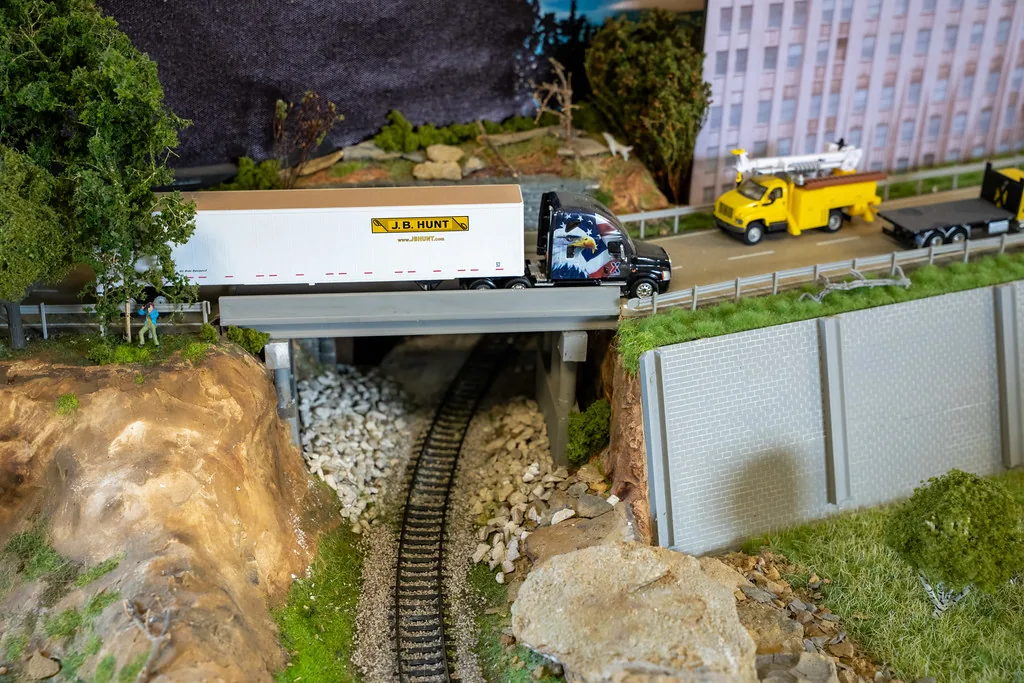
A road can occupy a convincing strip of scenery while leading nowhere useful. It may meet a factory on the wrong side, stop at a platform without an entrance or disappear behind a building in a way that contradicts the scene. Before choosing its surface colour, draw the journeys it is meant to support.
The NMRA structures guide links buildings with the surrounding roads, paths and working areas. Its scenery and planning guides place these features within the broader layout. A circulation sketch translates those relationships into a modest design exercise. It does not establish real road-engineering dimensions, traffic rules or the exact arrangement of a historic site.
Choose the journeys that matter
Name the activity at each important building. A passenger entrance, a loading point and a maintenance door imply different approaches. For a fictional station, you might need a pedestrian route from the scenic boundary to the entrance and a separate implied service area. Keep the example's assumptions explicit.
If the model represents a named place, research the actual arrangement rather than assigning a familiar modern pattern. A photograph may show a visible entrance without revealing the road connection outside the frame. Record that limit and seek another view if the missing relationship matters to the claim of accuracy.
Draw connections as arrows
Use arrows before drawing finished road edges. Connect the scenic boundary, building access and relevant working space. This keeps attention on where movement begins and ends. A road shape that looks attractive from above should still explain a journey when its surface detail is removed.
Separate pedestrian, vehicle and railway movements where the scene needs that distinction. Do not invent a crossing arrangement merely because two drawn lines intersect. For a prototype-specific scene, obtain evidence of the relevant feature. For a fictional scene, choose a clear visual relationship and avoid presenting it as a technically approved real-world traffic solution.
Place the actual models
Use the building footprint and representative vehicle sizes to check the proposed space. Include projecting roofs, steps and loading platforms. A building entrance can become inaccessible when its true shape replaces the simple rectangle used during early planning.
Paper or card models are useful for comparing alternatives. Mark vehicle footprints without claiming they prove real turning performance. If an exact historic or technical manoeuvre is central to the scene, research it appropriately. For general composition, the exercise should at least expose an obvious dead end or an entrance blocked by an accessory.
Make the off-scene continuation legible
A road need not remain visible across the entire layout. It can suggest continuation beyond the model or behind a well-placed feature. Examine that transition from the actual viewing positions. The viewer should understand that the route continues, rather than seeing an unexplained abrupt stop against a backdrop.
Try a temporary arrangement before permanent surface work. A small change in angle or building position may resolve the transition more convincingly than a dense screen of trees. Keep the screen from becoming a new obstruction to track clearance or maintenance. The scenic explanation and the real operator's access need to coexist.
Connect ground treatment with use
Once the circulation is coherent, map surface differences that support it. A working yard, a path and an unused edge can have different visual character. Choose suitable references and keep specific material claims tied to evidence rather than identifying every pale patch as a particular surfacing method.
Prepare samples under the intended lighting. A large bright road can dominate a small scene even when its colour resembles a reference in isolation. Judge it beside buildings, ground cover and trains. The aim is a surface that clarifies movement and setting without unintentionally becoming the main subject of the railway.
Keep crossings and mechanisms accessible
Where scenic routes approach working track or moving components, preserve the required clearance and access. Do not allow surface material, loose scatter or a fixed model vehicle to interfere with the intended railway movement. Follow the actual equipment requirements and inspect affected areas before operation.
If a scenic road section must be removable, identify the join and the lifting procedure. Place its edges where they can be handled without damaging nearby detail. A continuous-looking surface is valuable only if it does not conceal a maintenance problem that must be broken apart every time attention is needed.
Finish with a route check
Trace each intended journey on the final mock-up and compare it with the original arrows. State what continues beyond the scene and what is deliberately omitted. Keep photographs of the arrangement and the sources supporting any prototype-specific claims.
The finished road does not need miniature traffic to justify itself. It needs a readable relationship with the places it serves. Planning arrival, access and continuation first gives a modest scenic strip a clear purpose and prevents a carefully finished surface from becoming an attractive route to nowhere.
Take it to the workbench
A field sheet for this article. Use your browser’s print command or copy the headings into your project notebook. Keep facts, observations and open questions distinct.
| Journey and destination | Your notes |
|---|---|
| Building entrance | Your notes |
| Vehicle or path footprint | Your notes |
| Off-scene continuation | Your notes |
| Ground and track boundaries | Your notes |
Follow the entrance arrow
Hypothetical worked example. The fictional road reaches the warehouse, but the loading opening faces a fence. Rotating a card building exposes a usable relationship without adding another road. The result is scenic plausibility, not proof of full-size vehicle turning clearance.
This is an editorial exercise, not a report of a physical test.
Sources & further reading
- National Model Railroad Association — Structures
- National Model Railroad Association — Scenery
- National Model Railroad Association — Layout Planning
Sources support the factual background. Worksheets and hypothetical exercises are editorial proposals, not reports of tests performed by this publication. Consult the relevant current product documentation before applying product-specific advice.