Choose a season across the whole scene
Keep foliage and ground colours consistent. A reference-led palette and contradiction checklist.

A scene can contain attractive individual colours while suggesting several seasons at once. Fresh foliage, bare trees, dry ground and a backdrop with a different character may each be plausible somewhere, but their combination needs a reason. Choosing a season is therefore less about selecting a favourite green than about coordinating the evidence and visual cues across the whole scene.
The NMRA scenery guide encourages reference-led decisions about ground and vegetation. Its weathering guide distinguishes specific references from general interpretation. Library of Congress photograph-care guidance is relevant when those references are physical prints. The palette exercise below organises a modelling decision without claiming a botanical calendar for every place.
Define place and intention together
State whether the model depicts a specific location and period or a fictional setting with a broader inspiration. Add the seasonal character you want to communicate. A precise historic reconstruction needs evidence proportionate to that claim; a fictional scene can use a clearly stated visual interpretation.
Avoid using a month alone as a complete colour specification. Conditions vary by region, weather and the particular landscape. Research comparable references rather than assuming that one conventional calendar image applies universally. If the evidence is limited, describe the scene in broader terms instead of inventing a precise date to make the notes appear complete.
Gather a coherent reference group
Choose a small set of images that show the kinds of ground, vegetation and buildings relevant to the scene. Preserve source, stated date and location. Distinguish an original image from a repost, and do not treat several copies of one photograph as independent evidence.
Compare the references for differences in lighting and processing. A warm image does not necessarily show a different season from a cooler one. Record what can actually be observed, such as bare branches or a pattern of ground cover, and keep interpretations separate. A colour sample taken from a screen is a visual aid, not a precise material specification.
Build a role-based palette
Assign colours to roles rather than collecting unrelated swatches. Include dominant ground, secondary ground, vegetation masses, built surfaces and any small accent that matters to the scene. Record which references support the relationships and which are editorial choices for the fictional composition.
Keep the palette small enough to use consistently. Variation can occur within a role without giving every area a separate dominant colour. Place the proposed samples together and compare their relative strength. A brightly coloured scenic product may need a different role from the one suggested by its packaging photograph.
Check the large surfaces first
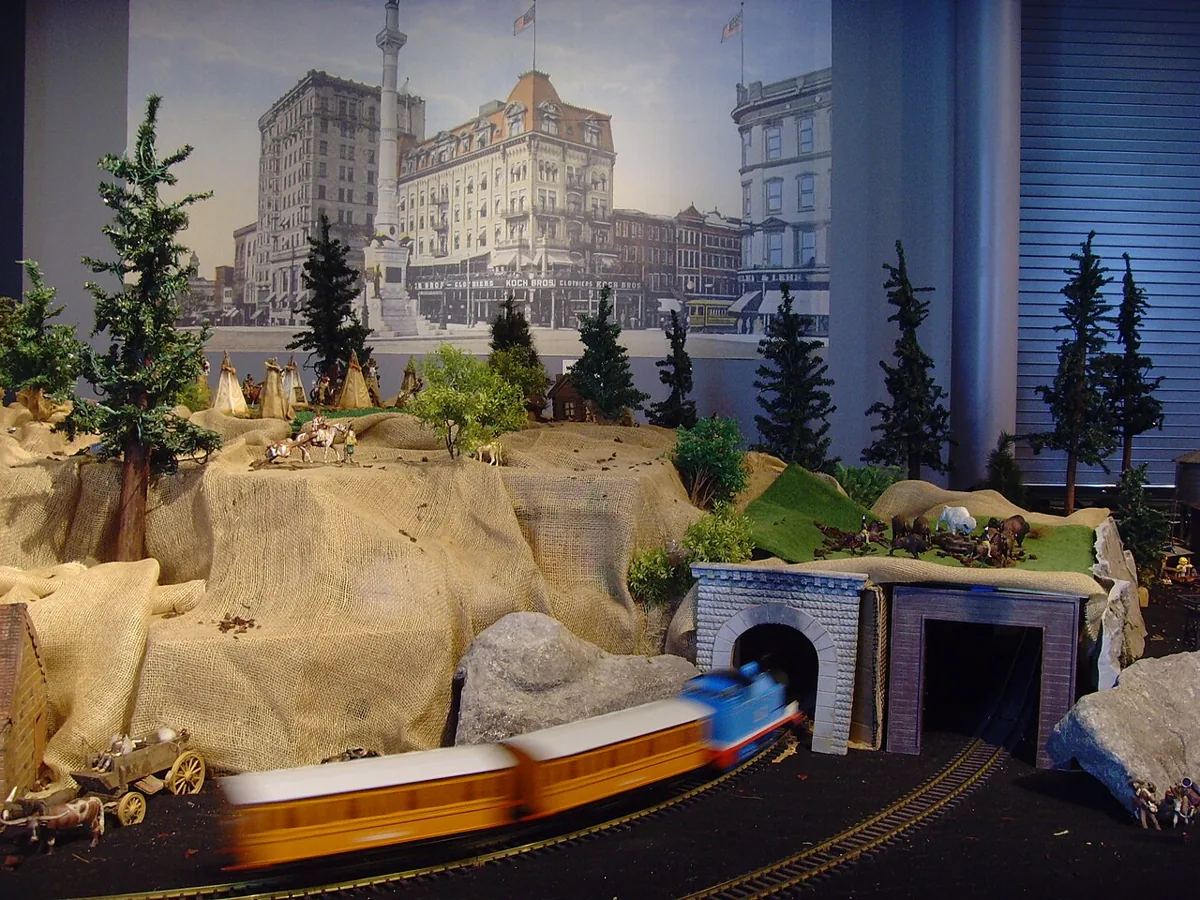
Ground, tree groups and backdrop occupy much more of the view than a tiny accessory. Compare those large areas before refining individual details. A well-painted sign cannot resolve a conflict between a lush foreground and an unrelated distant landscape.
Use temporary samples under the intended layout lighting. Include representative buildings and vehicles so the judgement concerns the complete composition. Record whether a colour relationship remains visible from the normal viewing distance. This is an assessment of the scene's appearance, not a measured claim about the accuracy or durability of a particular paint or scenic material.
Make a contradiction list
Write down the strongest seasonal cues in the model: tree form, ground state, vegetation colour and any clearly seasonal activity. Compare each with the stated intention and references. Ask whether a difference is supported, a deliberate fictional choice or an accidental mismatch.
Do not remove every variation simply to make the scene uniform. Real references can contain contrasts. The exercise asks for a reasoned relationship, not a single colour applied everywhere. When a striking contrast is supported by the evidence or central to the scene, preserve it and record why it belongs.
Keep weathering related but distinct
Surface wear and deposits can influence the palette, but age and season are not the same question. The NMRA weathering discussion provides a useful separation between a general effect and a documented condition. Avoid using one dark treatment to force unrelated objects into apparent agreement.
Plan material application separately, following current instructions and checking compatibility with the actual substrate. Keep reference interpretation apart from product performance. A convincing sample under one light does not establish that a coating is suitable for every model or that its appearance will remain unchanged indefinitely.
Preserve the palette record
Retain labelled samples, reference links and photographs of the scene under its intended lighting. For physical prints, follow suitable handling and enclosure guidance rather than annotating fragile originals. Link your working notes to the source identifiers.
Revisit the record when adding a new tree group or extending the backdrop. Compare additions with the chosen relationships before fixing them permanently. A seasonal palette succeeds when the whole scene offers a coherent impression supported by its references and declared choices. It should make later decisions easier, while leaving room for the variation that gives a landscape character.
Take it to the workbench
A field sheet for this article. Use your browser’s print command or copy the headings into your project notebook. Keep facts, observations and open questions distinct.
| Place and seasonal intention | Your notes |
|---|---|
| Dated reference group | Your notes |
| Dominant colour roles | Your notes |
| Conflicting seasonal cues | Your notes |
| Lighting and material samples | Your notes |
Do not average seasons
Hypothetical worked example. The foreground reference has bare branches while the proposed backdrop is densely leafy. Identify whether the difference is supported by place or species. If not, change a major reference before trying to hide the contradiction with one uniform ground colour.
This is an editorial exercise, not a report of a physical test.
Sources & further reading
- National Model Railroad Association — Scenery
- National Model Railroad Association — Weathering
- Library of Congress — Care, Handling, and Storage of Photographs
Sources support the factual background. Worksheets and hypothetical exercises are editorial proposals, not reports of tests performed by this publication. Consult the relevant current product documentation before applying product-specific advice.