Place trees as a landscape, not a collection
Plan tree groups around scale, sightlines and access. A canopy footprint plan with maintenance space.
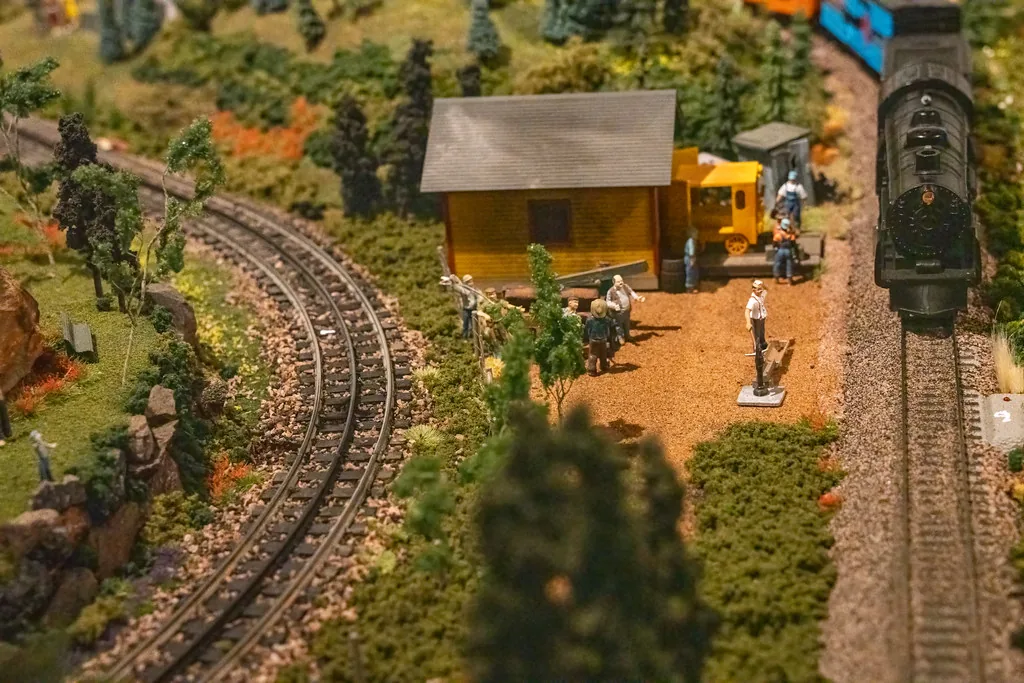
A box of attractive model trees is not yet a landscape. Their placement determines what is framed, what is hidden and how large the surrounding scene appears. Planning the spread of the canopy, rather than marking only trunk positions, can prevent a convincing station or carefully designed access route disappearing behind foliage at the final stage.
The NMRA scenery guide discusses trees as part of the scenic sequence. Its planning guide emphasises maintenance access, and its structures guide relates buildings to their setting. A canopy-footprint plan combines those concerns. It is a composition exercise, not a botanical planting prescription or a claim about the ecology of a specific railway location.
Choose a landscape role
Decide what the trees contribute: a background mass, a boundary, a frame for the train or a prominent individual feature. Keep the role linked to the scene's subject. A foreground tree can be beautiful while obscuring the movement the layout was designed to show.
Use reference material appropriate to the intended place and season where those identities matter. If the scene is fictional, describe its visual inspiration rather than asserting an exact natural community without research. A model tree's commercial name is not sufficient evidence that its form, colour and setting accurately represent a particular species or landscape.
Draw the canopy, not just the trunk
On the plan, mark the approximate spread of each important tree or group. Include its relationship with buildings, roads and railway clearance. A trunk can stand well outside the track while branches extend into a space needed by a moving vehicle or the operator's hand.
Use the actual model dimensions where available. If trees are not yet selected, make the uncertainty visible and use temporary forms to explore the arrangement. Avoid treating a small pencil dot as a complete reservation of space. Canopy planning explains why a group that fits easily in a catalogue photograph may crowd a compact layout.
Think in groups and gaps
Compare the outline of the whole group before placing every tree. A dense background mass and a few separated foreground forms create different views. Leave deliberate openings where the train, a building entrance or an important landscape relationship needs to remain visible.
Do not impose a universal spacing pattern from the modelling bench. Observe suitable references and decide what the miniature scene needs to communicate. A repeated evenly spaced arrangement may be appropriate for a deliberately managed setting, but it should be a supported or stated choice rather than the accidental result of using every tree in the packet.
Check height from the normal view
Place temporary silhouettes at the proposed heights and examine them from the intended viewing positions. Looking down on a plan hides the way a canopy can merge with a roof or compete with a train. A modest change in position may clarify the whole scene without changing the number of trees.
Photograph two or three alternatives under comparable conditions. Write what each reveals and conceals. These are visual observations, not proof of realism. If reproducing a particular place, compare the selected arrangement with its sources; if composing a fictional scene, judge whether the chosen relationship supports its stated subject.
Preserve working access
Mark coupling positions, track requiring routine attention and removable scenery. Include the space needed to lift a vehicle or structure, not only the space needed for trains to pass. A tree that is harmless during ordinary running can still make maintenance awkward.
Decide which trees are removable and how that is achieved in the actual build. Keep any removal method compatible with the model and substrate, following relevant material guidance. Store removable trees so their identity and intended position remain clear. A numbered plan can avoid repeatedly experimenting with placement each time access is needed.
Sequence the ground and foliage
The NMRA scenery guide notes that working around already placed trees makes adding smaller ground details more difficult. Use that principle to plan the construction sequence. Establish the important lower layers before a dense canopy limits access, while retaining any temporary trial needed to judge the composition.
Do not interpret sequence advice as a universal adhesive recipe. Materials, tree bases and scenic substrates differ. Follow actual product instructions and test an appropriate sample where compatibility is uncertain. The placement plan says where the trees belong; the construction method must still be suitable for what the models are made from.
Record the selected arrangement
Keep the canopy plan, relevant reference links, photographs of the mock-up and notes on removable pieces together. Describe the intended gaps as well as the planted areas. This preserves the landscape logic when future additions make empty-looking space tempting to fill.
Recheck the plan after major building or track changes. The same tree group can frame one arrangement and obstruct another. A successful miniature landscape comes from the relationships among trees, ground, structures and railway activity. Treating trees as part of that shared space produces a more coherent result than placing attractive individual objects wherever a trunk still fits.
Take it to the workbench
A field sheet for this article. Use your browser’s print command or copy the headings into your project notebook. Keep facts, observations and open questions distinct.
| Landscape role | Your notes |
|---|---|
| Canopy footprint | Your notes |
| Height and view | Your notes |
| Deliberate gaps | Your notes |
| Removable tree positions | Your notes |
A canopy conflict
Hypothetical worked example. The trunk misses the track, but the temporary canopy blocks the hand path to a coupling. Moving the trunk a little may not clear that canopy. Compare its full silhouette and the actual intervention before fixing the tree base.
This is an editorial exercise, not a report of a physical test.
Sources & further reading
- National Model Railroad Association — Scenery
- National Model Railroad Association — Layout Planning
- National Model Railroad Association — Structures
Sources support the factual background. Worksheets and hypothetical exercises are editorial proposals, not reports of tests performed by this publication. Consult the relevant current product documentation before applying product-specific advice.